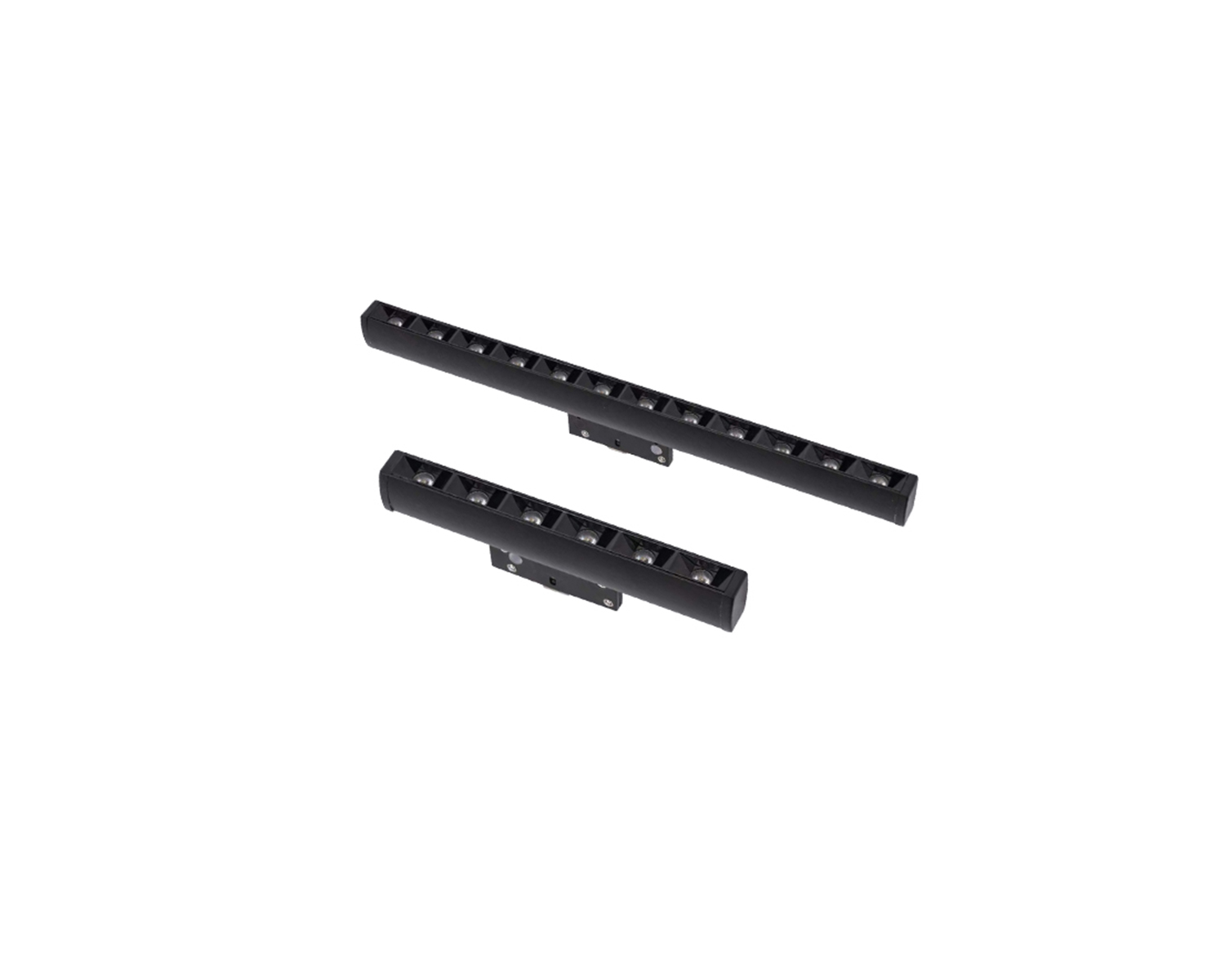
01A good-looking head can still do the wrong job
Commercial track lighting fixtures are often selected from a photograph of the housing. That is a reasonable way to judge visual bulk, but a poor way to judge the light. Start with the surface: a vertical wall, a narrow shelf, a sculptural object or a table. Then consider the distance and direction available from the rail. The housing becomes meaningful when it contains an optic suited to that task.
A fixture also occupies the visitor's view. Look at the likely approach to the room, the normal standing position and any seated positions. A bright aperture that sits comfortably above a display might become intrusive across a dining table. Adjustment and shielding can help, but they should be considered before the rail is fixed. There is a difference between lighting the subject and pointing a visible source toward the person looking at it.
Keep the visual hierarchy in mind. If every fixture creates an isolated bright pool, the room can feel restless even when each object is individually legible. Some surfaces need a broad, even wash; others benefit from a smaller accent. Decide how those layers relate. A mixture of optical jobs can be more useful than a ceiling filled with identical heads performing slightly different compromises.
02The beam edge matters too
Ask to see how the proposed beam behaves beyond its centre. A pronounced edge may work for a deliberately isolated object and look awkward on a long display wall. A softer transition can join neighbouring pools more gracefully, but may allow light onto areas intended to remain subdued. Compare the distribution with the actual size and spacing of the subjects rather than treating beam angle as a badge of quality.
Adjustable-focus optics offer a way to alter the pool, but the useful range still has to suit the application. Check what happens to the edge, the intensity pattern and the fixture's physical position as it changes. A mechanism that is convenient to adjust should also remain stable after aiming. For frequently changing displays, the practical feel of the adjustment matters alongside the optical result.
Grille-style arrangements and spot-style heads create different visual rhythms on a rail. Consider the scale of each against the room and the direction in which light needs to travel. A linear-looking fitting does not automatically provide a suitable wall wash, just as a cylindrical head does not automatically produce a precise accent. Request optical information for the relevant model and inspect a sample under representative conditions.
03Colour, finish and the things being sold
Compare light on the actual materials where possible. A timber veneer, a deep green fabric and a polished metal object place different demands on the impression of colour and texture. Request colour-rendering information and discuss the intended colour temperature without assuming that one choice is best for every commercial setting. The room's daylight and background finishes will affect how that choice is perceived.
The exterior finish of a fixture has another role. A dark head may disappear against an exposed dark ceiling yet stand out against pale plaster. A pale head may blend with one ceiling and become conspicuous in a glazed storefront after dark. View the fixture in the context where it will be seen. Finish should support the interior composition without distracting from the object being lit.
For glare-sensitive uses, compare the apparent brightness of the aperture from relevant directions. Recessed sources, shielding and accessories can alter that experience, but each proposed configuration needs checking as a whole. On artwork, include reflected glare from glazing. At desks, include screen reflections. The artwork lighting guide and office scene brief examine these distinct viewing problems.
04Check what the fixture connects to
Confirm the adapter interface, rail wire count and voltage before approving the head. With existing track, collect model markings and technical documents rather than selecting a replacement by appearance. Have an electrician assess retained equipment. Compatibility is an electrical and mechanical requirement; the ability to place a head near a rail does not establish that the two should be connected.
Dimming introduces another relationship. Describe the control method and ask for the complete compatible light source, driver and control arrangement. Test quiet scenes as well as the bright setting. A restaurant buyer cares about how a fitting behaves when the room settles for dinner; a showroom buyer may care more about independent display groups. Use the operating need to decide what the fixture specification must answer.
Create a shortlist that records the intended surface, optic, aiming position, finish, rail connection and control requirement for each fixture role. This makes substitutions easier to evaluate and helps avoid buying several attractive heads with no clear division of work. For the broader arrangement, turn to commercial track lighting systems. For a purchasing discussion, send a drawing and the difficult surfaces first; those details narrow a choice more effectively than a request for a popular model.
Keep photographs of the approved sample beside its model reference and selected configuration. A sample remembered only by colour or shape can be confused with another variant when purchasing begins. Record the optic, finish, adapter and control details that mattered in the trial so the eventual order can be checked against the choice that was actually evaluated.