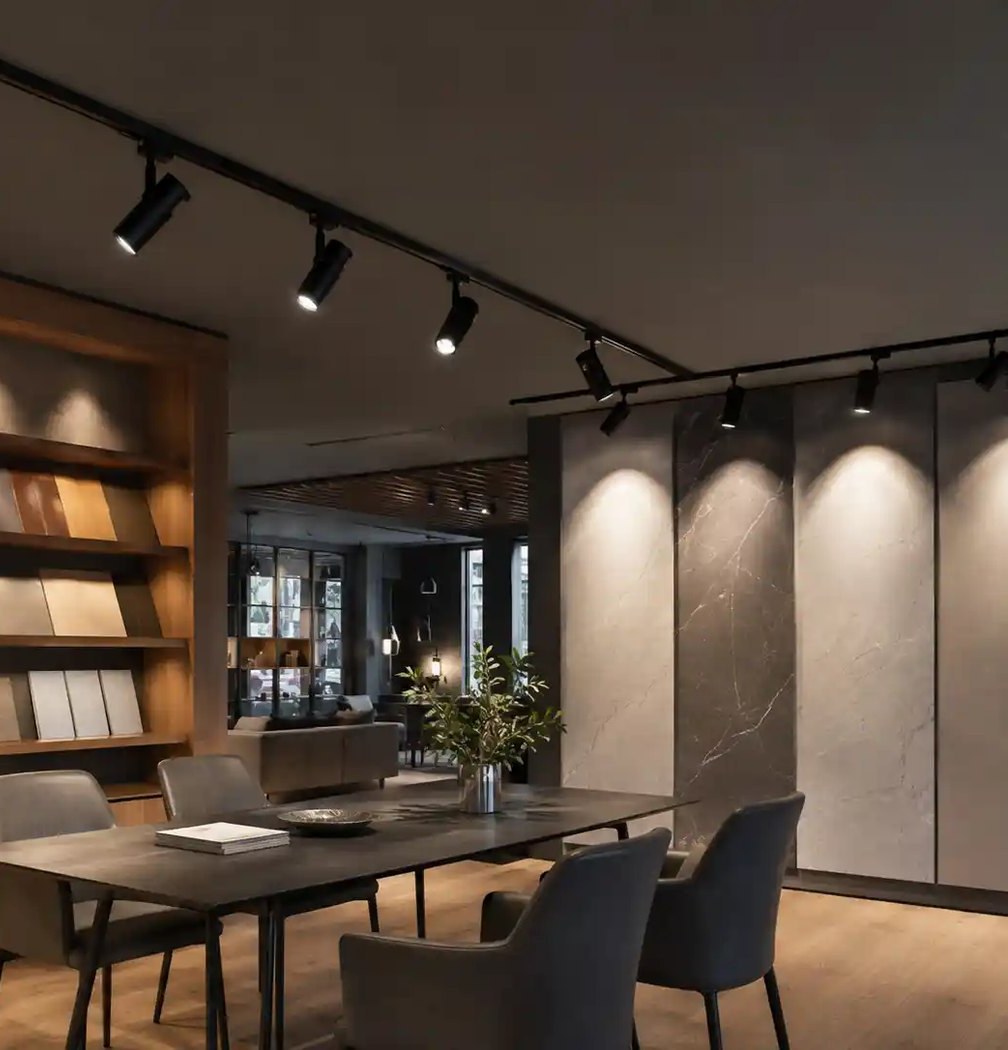
What ‘commercial’ changes
A home might use its track lighting for a few hours each evening. A shop, restaurant, hotel or office often runs it for most of the day, every day, and that changes what matters. Long operating hours put more weight on heat management, build quality and how easily a failed head can be swapped. Layouts change with seasons, menus and exhibitions, so re-aiming has to be quick and safe from a ladder. Groups of lights need to switch together for opening, cleaning and closing. Ceilings are higher and busier, so maintenance access deserves its own line in the brief.
None of that is exotic, but it's the reason commercial rooms are specified differently from a living room. The room's behaviour comes first; the essays on retail, restaurants and galleries cover that judgement in detail.
System choices in commercial rooms
Conventional rail with interchangeable heads is the workhorse. Rails come in 2, 3, 4 and 6-wire versions, with power feeds, straight, L and cross connectors, and suspension or recessed parts for different ceilings. More wires can allow heads to be split across circuits, but which grouping or dimming arrangement a given system supports is confirmed per system, never assumed from the wire count.
Magnetic track fits some commercial briefs: a slim line in a showroom, a modular run in an office or a boutique. The M35 35mm profile is aimed at larger commercial fixtures in shops, museums and offices. The M25 25mm profile is a residential and light-duty system, and we don't present it as a commercial default. There are also 48V profiles: a 20mm track, a 26mm ultra-thin track with right-angle and rounded corners, a light-strip belt and a semi-flexible version. Bodies are extruded aluminium with brass conductors and flame-retardant PVC, in black or white baked paint, for surface, recessed or suspended mounting, with lengths of 1.0, 1.5, 2.0 or 3.0 m as options per model. High-voltage options run on 95–260V without a transformer.
Pick the system for how often the room changes. Pick the head for what the light has to do.
Downlights do the general work around the accent: circulation, back-of-house, corridors and the ambient layer on a sales floor. GU10 and MR16 frames in aluminium, iron or plastic, COB downlights including twin-head recessed, adjustable and anti-glare versions, SMD integrated and panel types, and E27 models cover most of that. Smart versions are available on selected models — platform to confirm with our team.
Heads for commercial accent work
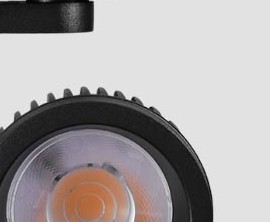
GU10 and MR16 heads take replaceable lamps and suit lower-output accent work and display shelving. COB heads give a single, clean source and come in adjustable-focus and dimmable variants on selected models, which is why they're common in commercial accent lighting. E27 heads take PAR20 or PAR30 lamps where an operator wants to source lamps locally.
Two rules apply to every head. First, keep complete lights and housings apart in the order: a housing without its lamp or module is a different item and should be quoted as one. Second, every head has to match the rail's wire system and the supply voltage. We confirm both per model before a quote is final.
A word on runs and access
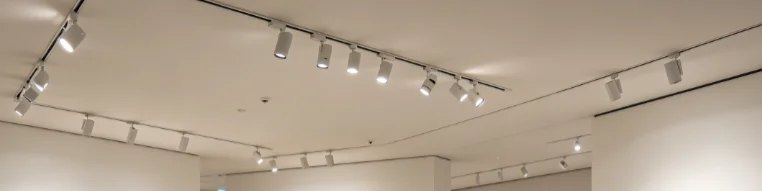
A long, continuous run reads as part of the architecture and gives heads somewhere to go when the room changes. Short, scattered runs tend to lock the layout in place. Whatever the pattern, check that every head can be reached and re-aimed without moving fixed furniture or closing the room for a day.